Axia Extract vs Amazon Textract.
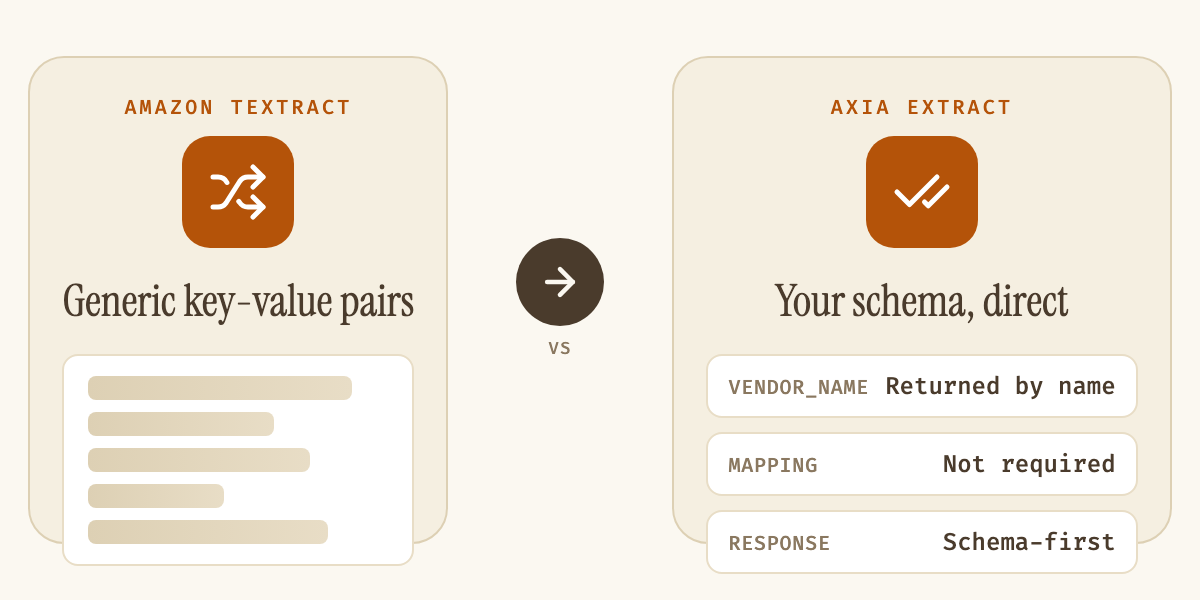
Textract wins on price for raw text at $0.0015/page. For structured extraction, Axia Extract costs less than half of Textract's $0.07 bundle per page and returns your defined schema instead of generic key-value pairs.
Side by side
Raw OCR bundle vs. schema-first extraction.
| Amazon Textract | Axia Extract | |
|---|---|---|
| Raw OCR (text only) | $0.0015/page | Not the use case — every tier returns structured fields |
| Structured extraction | $0.01–$0.07/page by API | $0.0056–$0.0323/page (Small & Standard) |
| Output shape | Generic key-value pairs, table cells | Your defined schema, nested fields included |
| Published accuracy benchmark | ||
| Setup required | Response-mapping code per use case | Point-and-click schema |
Pricing per AWS's public Textract pricing page and Axia's live credit pricing, both checked September 2026. Full breakdown in our Axia vs Textract guide.
Benchmarked accuracy
98.2% field accuracy, published openly.
98.2%
Axia Extract — published SROIE2019 benchmark
Not published
Amazon Textract — no per-field benchmark
Benchmarked against SROIE2019, a public dataset of 347 real-world receipts. Amazon does not publish a comparable per-field benchmark for Textract.
See the full accuracy reportFAQ
Axia Extract vs Textract, answered.
Is Amazon Textract cheaper than Axia Extract?
How much does Amazon Textract cost per page?
Does Axia Extract publish accuracy numbers against a benchmark?
Do I still need to write code after using Textract?
Which one should I pick?
Skip the response-mapping layer.
Upload a real document and get your defined schema back directly, no key-value parsing required.
What Textract's price tag doesn't include.
Amazon Textract is the default answer for teams already living inside AWS, and for raw OCR with no schema behind it, its $0.0015/page rate is unbeatable. But most teams reaching for Textract aren't after raw text, they want a specific field like vendor name or invoice total, and that's where the real cost shows up: not on the AWS bill, but in the engineering time spent mapping generic key-value pairs into your own data model.
| Textract API | Returns | Price/page |
|---|---|---|
| Detect Document Text | Raw characters, no structure | $0.0015 |
| Analyze Document, Signatures | Signature presence/location | $0.0035 |
| Analyze Expense | Receipt/invoice line items | $0.01 |
| Analyze Document, Tables | Table cells | $0.015 |
| Analyze ID | ID document fields | $0.025 |
| Analyze Document, Custom Queries | Answers to defined questions | $0.025 |
| Analyze Document, Forms | Key-value pairs | $0.05 |
| Analyze Document, Forms+Tables+Queries | All three combined | $0.07 |
Per AWS's public Textract pricing page, checked September 2026. Full head-to-head math in our Axia vs Textract pricing breakdown.
Axia Extract skips that mapping layer entirely. Defineinvoice_total or vendor_name once as a schema field and every call returns it by that name, whether the source is an invoice, a purchase order, or a signed contract. Our full Axia vs Textract pricing breakdown walks through every API tier Textract offers and where each one lands against Axia's per-page credit rate.
If you're deep in AWS with IAM roles and Lambda triggers already wired up, that operational continuity has real value, and Textract's free tier makes a proof of concept effectively free. But if your team would rather see structured fields on the first call instead of parsing three different response shapes, check the API documentation and run a real document through both before you build around either one.