Axia Extract vs Infrrd.
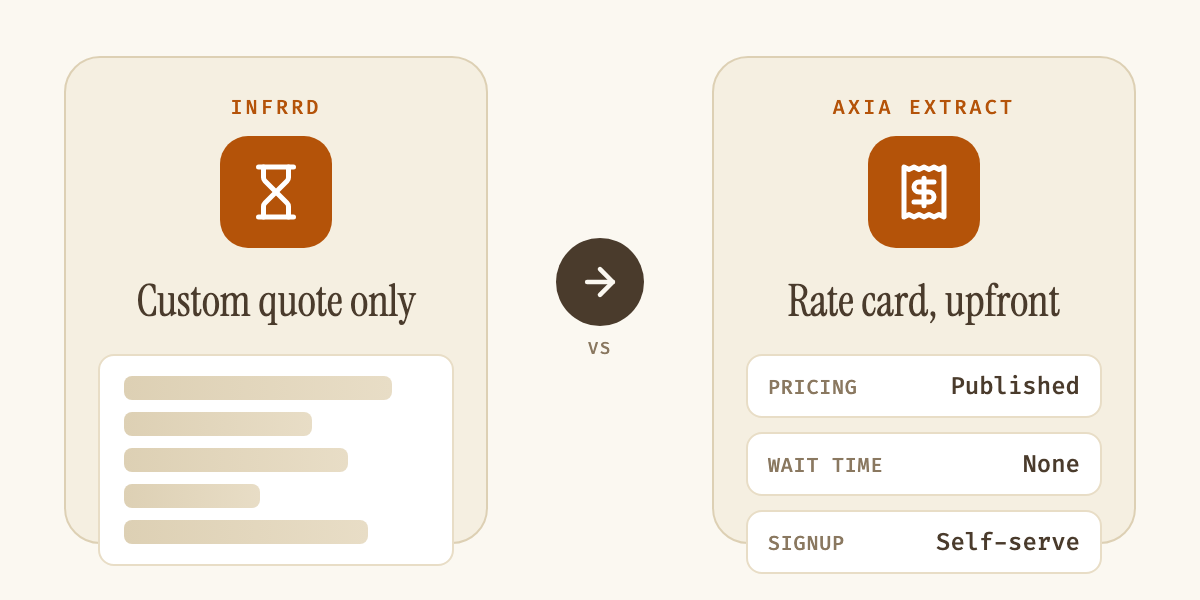
Infrrd prices performance-based, by custom quote, with a managed human-in-the-loop review option. Axia Extract publishes credit pricing openly and returns a confidence score on every field for your own review workflow.
Side by side
Custom quote vs. published credit pricing.
| Infrrd | Axia Extract | |
|---|---|---|
| Pricing basis | Performance-based, custom quote | Published credits per page |
| Published pricing | ||
| Self-serve signup | ||
| AI-based, no template | ||
| Human-in-the-loop review option | Confidence score routes low-confidence fields | |
| Published accuracy benchmark | ||
| REST API | ||
| Free trial | Custom demo |
Infrrd pricing and features per its public pricing page, checked September 2026. Infrrd revises its offering periodically — confirm current terms before budgeting.
Benchmarked accuracy
98.2% field accuracy, published openly.
98.2%
Axia Extract — published SROIE2019 benchmark
Not published
Infrrd — no public per-field benchmark
Benchmarked against SROIE2019, a public dataset of 347 real-world receipts. Infrrd does not publish a comparable public per-field benchmark.
See the full accuracy reportFAQ
Axia Extract vs Infrrd, answered.
How does Infrrd pricing compare to Axia Extract?
Does Infrrd offer a free trial?
What's the difference between Infrrd's Human-in-the-Loop and Axia's confidence scoring?
Does Infrrd publish accuracy benchmarks?
Which is better for a small or mid-size team?
See a clear per-page rate.
Test extraction on your own documents with published pricing, no custom quote required first.
Infrrd vs Axia Extract, quote vs published rate.
Infrrd's performance-based model, pay for the results you see, sounds simple, but the actual rate only shows up after a sales conversation and a custom quote. That works fine for large mortgage and insurance operations with the time to run an RFP. It's a slower path for a team that wants to know its cost per page before writing a single email.
| Service | What it does |
|---|---|
| IDP | Core automation platform |
| Human-in-the-Loop | Automation plus managed human review, SLAs from <15 min to 24 hrs |
| No-Touch Processing | Fully automated, zero human intervention |
| AI Agents ("Ally") | Broader business process automation |
All four are quoted individually. Axia Extract runs one engine with one published rate, and a confidence score stands in for a managed review queue.
Axia Extract's credit rates are published outright, 1 to 12 credits per page depending on schema complexity, so a claims team or a lending operation can estimate total spend from expected volume alone. Infrrd's Human-in-the-Loop option adds managed reviewers on top of its automation, useful if you want the vendor to own the review queue; Axia's per-field confidence score gives you the same signal to build a review step inside your own workflow instead. Our insurance claims automation guide names Infrrd directly and covers what to ask any IDP vendor beyond a single accuracy claim.
If your document volume already justifies an enterprise contract and a managed review team, Infrrd's model can work well. If you'd rather see a fixed number before you commit, start with Axia's published rate and compare it against whatever quote comes back, and see how Axia stacks up against another enterprise IDP vendor, Hyperscience, while you're evaluating options.