Axia Extract vs Nanonets.
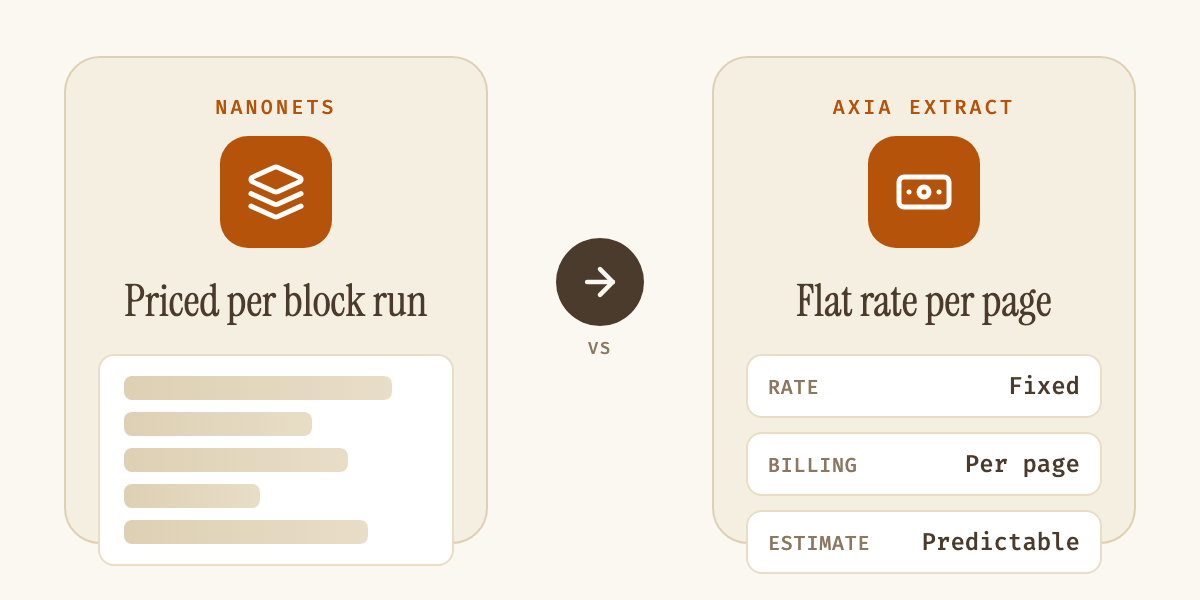
Both are AI-based, no-template extraction tools. The pricing models differ: Nanonets charges per workflow block run, complexity-priced, while Axia Extract charges a fixed rate per page by extraction model.
Side by side
Block-run pricing vs. flat per-page pricing.
| Nanonets | Axia Extract | |
|---|---|---|
| Pricing basis | Per block run, $0.02–$0.30, complexity-priced | Per page, by extraction model |
| Pricing published for extraction | ||
| AI-based, no template | ||
| Handwriting support | ||
| Confidence score per field | ||
| Published accuracy benchmark | ||
| REST API | ||
| Free trial | $50 in credits |
Nanonets pricing and features per its public pricing page, checked September 2026. Nanonets revises pricing periodically — confirm current rates before budgeting.
Benchmarked accuracy
98.2% field accuracy, published openly.
98.2%
Axia Extract — published SROIE2019 benchmark
Not published
Nanonets — no public per-field benchmark
Benchmarked against SROIE2019, a public dataset of 347 real-world receipts. Nanonets does not publish a comparable public per-field benchmark.
See the full accuracy reportFAQ
Axia Extract vs Nanonets, answered.
How does Nanonets pricing compare to Axia Extract?
Is Nanonets' pricing easy to estimate in advance?
Does Nanonets use templates or AI?
Does Nanonets publish accuracy benchmarks?
Which is better for high-volume, simple documents?
See a predictable per-page rate.
Upload a real document and get a clear credit cost, no block breakdown to estimate first.
Nanonets vs Axia Extract, by pricing predictability.
Nanonets and Axia Extract are close cousins: both AI-based, both template-free, both built with an API-first workflow in mind. The difference shows up on the invoice at the end of the month. Nanonets prices per workflow block run, so a document that touches extraction, classification, and a custom Python step stacks three separate charges before you know the total.
| Tier | Includes |
|---|---|
| Starter ($50 free, then $100/mo) | 100 credits/mo, data extraction AI, API access, up to 3 users |
| Growth (custom quote) | Classification AI, custom Python blocks, ERP integrations, up to 40% volume discount |
| Enterprise (custom quote) | SSO/SCIM, RBAC, HIPAA & SOC 2, private cloud deployment |
Beyond Starter, block-run pricing runs $0.02 to $0.30 per run depending on operation complexity, before any volume discount is applied.
Axia Extract instead charges a fixed credit rate per page, set by which extraction model your schema needs, published in full on the pricing page. That matters most for teams running high volumes of simple, repetitive documents, receipts, standard invoices, single-page forms, where the Small tier's flat per-page rate is easier to forecast against a monthly budget than a variable block-run total. Our breakdown of Axia's model tiers shows exactly which schema shapes land in each pricing bucket.
Neither tool requires a template, and both return confidence scores worth building a review queue around. If your workflow is genuinely complex, multiple AI blocks chained together, Nanonets' flexibility may earn its cost. If it's mostly one document type at real volume, Axia's flat per-page rate is the easier number to plan around.