Insurance Claims Extraction.
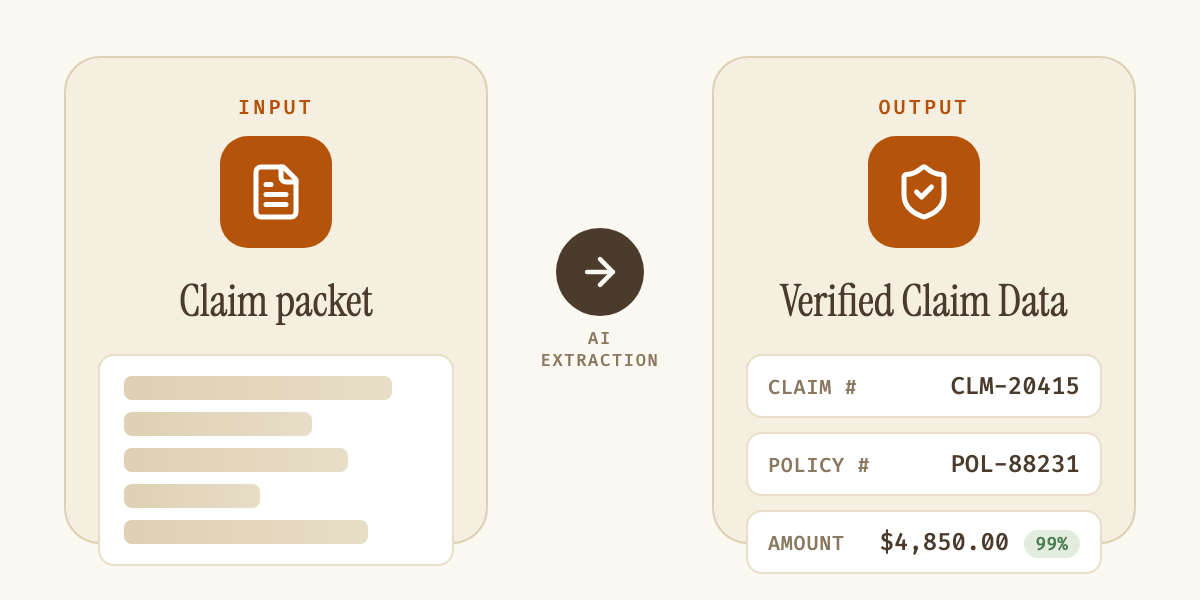
Insurance claims extraction reads claim forms, policy documents, and adjuster notes, then hands examiners structured data instead of a stack of PDFs to key in by hand. Axia Extract does it with AI, across carriers' different form layouts and handwriting, without a rebuild per template.
How it works
From claim packet to structured data, in three steps.
Define your schema
Claim number, policy number, loss date, claim amount, adjuster notes — the fields your claims system needs, defined once.
Upload the claim packet
Intake forms, repair estimates, EOBs, handwritten adjuster notes — mixed layouts, typed or handwritten, in one batch.
Get structured claim data
Every field back with a confidence score, ready for your claims management system or the API.
Who uses this
Built for claims teams under volume.
First notice of loss intake
Pull claim number, policy number, and loss date the moment a claim packet arrives, before an examiner opens it.
Adjuster notes & clinical abstracts
Read handwritten site-visit notes and dense clinical documents at usable accuracy, flagged by confidence score for review.
Fraud & subrogation review
Correctly captured fields make cross-referencing claims for fraud patterns possible in the first place.
Benchmarked accuracy
99.9% on claim amounts, 93.2% on handwriting.
99.9%
Claim amounts
93.2%
Handwritten fields
Benchmarked against SROIE2019, a public dataset of 347 real-world documents, with per-field results published openly.
See the full accuracy reportFAQ
Insurance claims extraction, answered.
What is OCR in insurance claims processing?
How is AI-powered claims extraction different from traditional OCR?
Can it read handwritten claim forms and clinical notes?
How accurate does it need to be for claim amounts?
Does it integrate with a claims management system?
See it read your claim packets.
Upload a real claim form and get structured data back in seconds, no template required.
Insurance claims extraction that keeps up with claim volume.
A single claim rarely arrives as one clean document. It's a packet: an intake form, an estimate from a repair shop or contractor, photos, sometimes a clinical abstract or an EOB, occasionally a handwritten note from an adjuster's site visit. Each piece uses a different layout, and most of them were designed for a person to read, not a machine. Insurance claims extraction exists to close that gap without adding headcount.
| Document type | Fields extracted |
|---|---|
| Intake form | Claim number, policy number, loss date, claimant name |
| Repair estimate | Parts, labor, total |
| Clinical abstract | Diagnosis, treatment date, provider |
| EOB | Amount billed, amount paid, patient responsibility |
Traditional OCR reads a fixed zone on the page and breaks the moment a carrier changes its form layout. Axia Extract's AI learns what a claim number or policy number looks like in context, so the same schema keeps working across different carriers' templates, without a rebuild every time a form changes.
A mid-size carrier processing a few hundred claims a week can lose dozens of staff hours to manual data entry alone, and that's before the cost of a transposed policy number sending a payout to the wrong file. Slow intake delays subrogation timelines, and inconsistent data entry makes fraud patterns harder to spot, since a reviewer can only cross-reference fields that were captured correctly in the first place.
Accuracy needs vary by field type. Financial fields like claim amounts drive payout, so Axia Extract publishes 99.9% accuracy on financial totals, benchmarked against SROIE2019, a public dataset of 347 real documents and detailed on the accuracy page. Handwritten fields, common on adjuster site-visit notes, average 93.2% accuracy. Every field returns its own confidence score, so a low-confidence entry can route to a reviewer instead of getting accepted silently. Our insurance claims automation guide covers what else to check before choosing a vendor.
Define the fields you need once, claim number, policy number, loss date, amount, adjuster notes, and that schema applies across every carrier's form from that point forward. The same approach works on policyholder ID verification during intake or repair receipt review during settlement, not just the claim form itself. Results export to CSV, JSON, or Excel, or pull directly through the REST API into your existing claims management system.