Document Extraction API.
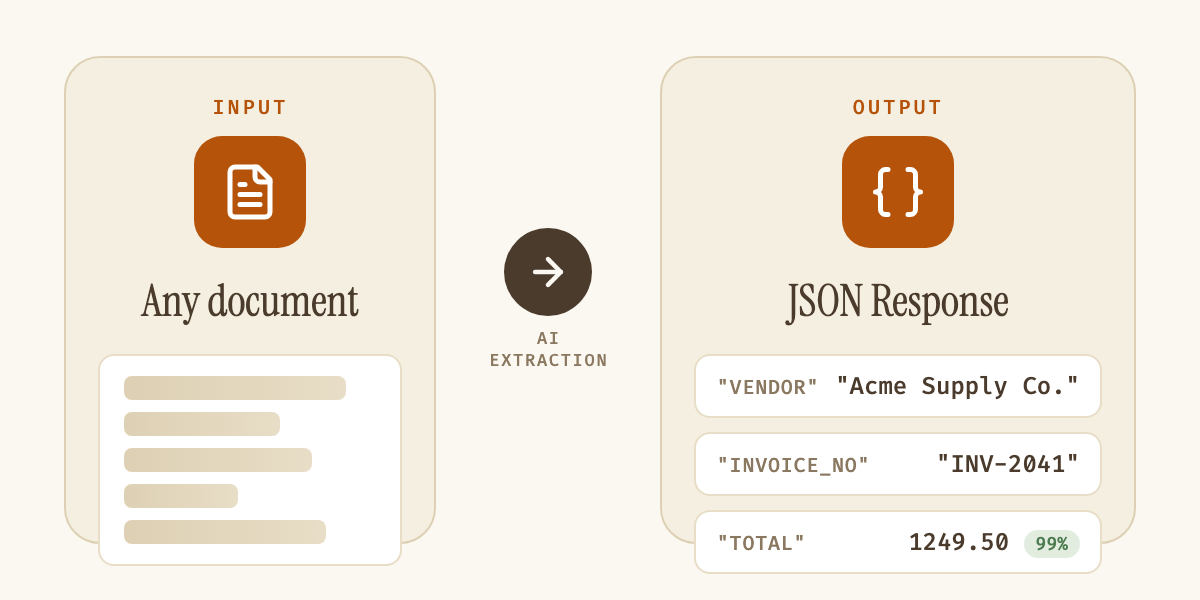
A REST API that returns your defined schema directly, not generic key-value pairs. Bearer token auth, JSON responses with a confidence score per field, and webhooks for async batches.
One call
Upload a document, get your schema back.
$ curl https://api.axiaextract.com/v1/extractions \
    -H "Authorization: Bearer $API_KEY" \
    -F document=@invoice.pdf \
    -F schema_id=inv_schema_01

{
  "status": "completed",
  "fields": {
    "vendor":     { "value": "Acme Supply Co.",
                    "confidence": 0.99 },
    "invoice_no": { "value": "INV-2041",
                    "confidence": 0.98 },
    "total":      { "value": 1249.50,
                    "confidence": 0.99 }
  }
}
API specifics
Built for a server-to-server integration.
Bearer token auth
One API key per account, sent as a standard Authorization header. No OAuth dance for a server-to-server integration.
Schema-first responses
Every call returns the exact fields you defined, nested objects and arrays included, each with a confidence score. No generic key-value pairs to parse.
Webhooks for async batches
Submit a document or a batch, get a webhook the moment results are ready. No polling loop required.
What the API supports
Everything the dashboard does, callable.
- Upload PDF, image, or scanned documents up to 50MB
- Define schemas via the dashboard or the API
- Bounding boxes for field-level positions, opt-in per request
- Bulk processing for large batches
- Export via API response, CSV, JSON, or Excel download
- Interactive documentation with code samples
Pricing
Credits per page, published openly.
1 to 12 credits per page depending on extraction model. No hidden multipliers, no annual contract to get started.
See the full credit rate tableFAQ
Document extraction API, answered.
How does authentication work on the Axia Extract API?
What does the response look like?
How is API usage priced?
Is there a rate limit?
Can I get webhook notifications instead of polling?
Is there a sandbox or free tier to test with?
Get an API key and test it live.
Send a real document through the API and see your schema come back structured.
A document extraction API that skips the mapping layer.
Most document extraction APIs hand back generic output: key-value pairs, table cells, or query answers that a developer still has to map into their own data model before it's useful. The Axia Extract API skips that step. Define a schema once, invoice_total, vendor_name, whatever fields your product needs, and every call returns exactly those fields, nested objects and arrays included, each with a confidence score attached.
| Model | Credits/page | Schema limit | Best for |
|---|---|---|---|
| Small | 1 | Up to 10 flat fields | High-volume, simple documents |
| Standard | 4 | Up to 20 fields, nested/array included | Mixed layouts and business documents |
| Large | 12 | No field cap | Long or highly varied documents |
Full rate card, including bounding-box and bulk-volume pricing, on the pricing page.
That schema-first design is what lets the same endpoint serve wildly different document types: an invoice, an ID document, a signed contract, without switching integration patterns for each one. It's a common building block for platforms embedding extraction inside their own product, a fintech onboarding flow, a claims portal, or an expense app, rather than shipping it as a standalone tool. Our guide to model tiers explains how schema complexity maps to credit cost per call.
Auth is a standard Bearer token, no OAuth flow to implement for a server-to-server integration, and webhooks handle async batches so there's no polling loop to write. Usage scales with your credit balance rather than a fixed rate-limit tier, and the full rate table lives on the pricing page so cost is predictable before you write the first line of integration code.