Purchase Order Extraction.
Purchase order extraction reads a PO document and pulls out vendor, line items, quantities, and totals, from any buyer's format. Axia Extract uses AI-powered OCR built for accuracy, so a new customer's PO layout works on the first try.
How it works
From purchase order to structured data, in three steps.
Define your schema
PO number, buyer, vendor, line items, quantities, unit price, delivery date — set the fields your procurement system expects.
Upload the purchase order
PDFs, scans, or emailed order forms, in any buyer's format. No template to build per customer.
Get structured order data
Line items and totals back with a confidence score per field, ready for order entry or the API.
Who uses this
Built for order-heavy teams.
Order entry & fulfillment
Read incoming purchase orders the moment they land and push line items straight into order processing.
Distributors & manufacturers
Handle POs from dozens of buyers, each with their own layout, without a template per customer.
Procurement & three-way match
Match PO data against invoices and receiving reports without re-keying either side by hand.
Benchmarked accuracy
98.2% field accuracy, 99.9% on totals.
98.2%
Average field accuracy
99.9%
Financial totals
Benchmarked against SROIE2019, a public dataset of 347 real-world documents, with per-field results published openly.
See the full accuracy reportFAQ
Purchase order extraction, answered.
What is purchase order extraction?
How is this different from invoice extraction?
Can it handle purchase orders from many different buyers?
How accurate is line-item extraction on purchase orders?
Does it integrate with an ERP or order management system?
See it read your purchase orders.
Upload a real PO and get structured line items back in seconds, no template required.
Purchase order extraction that scales with your buyer list.
Every distributor and manufacturer runs into the same wall: purchase orders arrive in as many formats as there are buyers. One customer emails a PDF, another sends a scanned fax, a third has its own procurement portal export. Purchase order extraction exists to read all of them into the same structured schema, without a template built per customer.
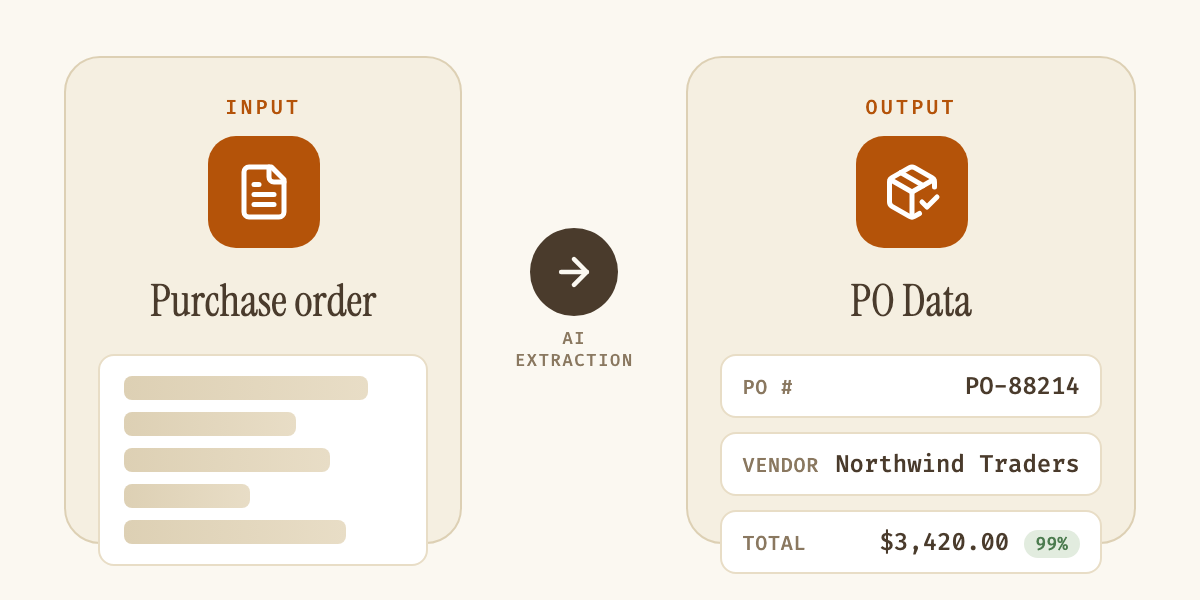
| Field | Example value |
|---|---|
| PO number | PO-88214 |
| Buyer / vendor | Northwind Traders / Axia Supply Co. |
| Line items | SKU, description, quantity, unit price |
| Delivery date | 2026-09-01 |
| Total | $3,420.00 |
Template-based order entry tools need a parsing rule per buyer's layout, and break when a customer's procurement system changes its export format. Axia Extract reads PO structure directly with AI, so a new buyer's format works on the first order, not after a support ticket and a rebuild.
Order entry and fulfillment teams use it to push line items straight into processing the moment a PO arrives. Distributors and manufacturers use it to handle POs from dozens of customers without a template per account, and the same schema-first approach carries into bills of lading and packing lists once the order ships. Procurement teams use it for three-way matching, comparing PO data against invoices and receiving reports without re-keying either side. Our guide to automating invoice processing covers the invoice half of that match.
Accuracy on line items and totals matters most here, since a misread quantity or price flows straight into an order. Axia Extract publishes its benchmark openly: 98.2% average field accuracy and 99.9% on financial totals, tested against SROIE2019, a public dataset of 347 real documents, detailed on the accuracy page. Every field returns its own confidence score, so a low-confidence line item can be flagged for review before it hits the order system. Results export to CSV, JSON, or Excel, or pull directly through the REST API into an ERP or order management system.