Bank Statement Extraction.
Bank statement extraction turns a PDF, scan, or photo into structured transactions, balances, and account details, from any bank's layout. Axia Extract reads it with AI-powered OCR built for accuracy, so income and cash-flow verification stops being a manual step in your pipeline.
How it works
From statement to structured data, in three steps.
Define your schema
Account number, statement period, opening and closing balance, individual transactions — pick the fields you need per applicant file.
Upload the statement
PDFs, scans, or photos, from any bank's layout. No template to build or maintain per institution.
Get structured transactions
Balances and transaction lines back as JSON with a confidence score per field, ready for underwriting or the API.
Who uses this
Built for teams that verify income and cash flow.
Digital lending & BNPL
Read three to six months of statements per applicant for approval and ongoing cash-flow monitoring, without a person opening each PDF.
Manual underwriting files
Handle statements from banks an aggregator doesn't cover, or applicants who won't share banking credentials.
Accounting & bookkeeping
Reconcile client bank statements against ledgers without re-keying transaction lines by hand every month.
Benchmarked accuracy
99.9% accuracy on totals, 96.3% on dates.
99.9%
Financial totals
96.3%
Dates
Benchmarked against SROIE2019, a public dataset of 347 real-world documents, with per-field results published openly.
See the full accuracy reportFAQ
Bank statement extraction, answered.
What is bank statement OCR?
How accurate is AI-powered bank statement extraction?
Does it work across different banks' statement formats?
Is there a REST API for lending platforms?
How is this different from a data aggregator like Plaid?
See it read your bank statements.
Upload a real statement and get transactions and balances back in seconds, no template required.
Bank statement extraction that reads any bank's layout.
Income and cash-flow verification is one of the last manual steps in most lending pipelines. Applications get submitted digitally, credit pulls happen through an API, but the bank statement, the document that actually shows whether someone can repay a loan, still gets opened, read, and keyed in by hand at a lot of shops. Bank statement extraction closes that gap.
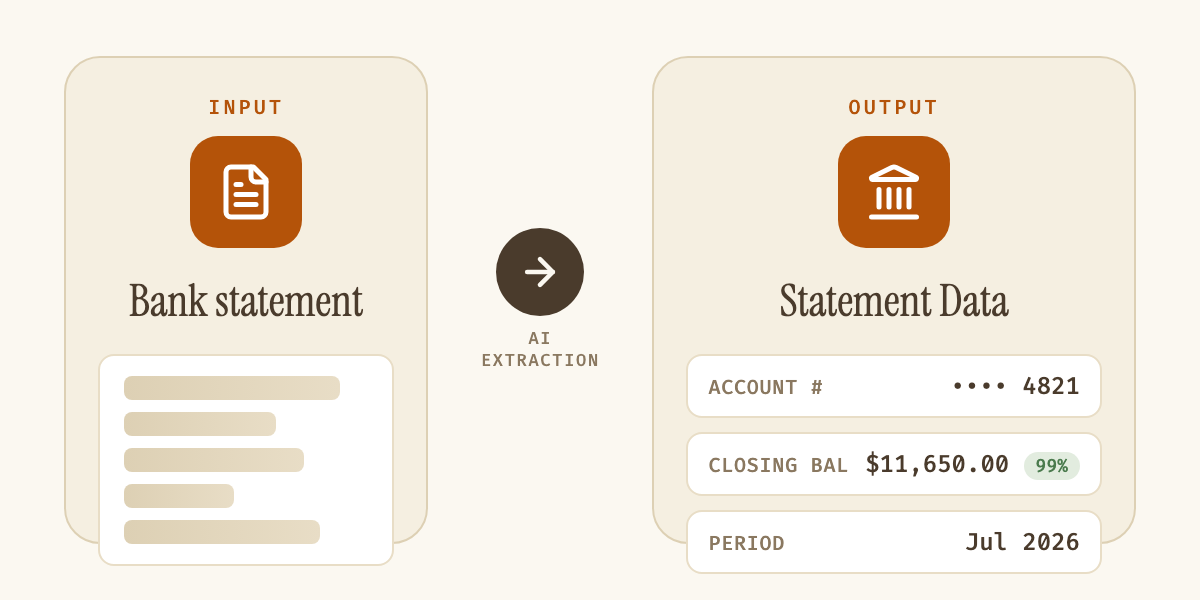
| Field | Example value |
|---|---|
| Account number | •••• 4821 |
| Statement period | Jul 1–31, 2026 |
| Opening / closing balance | $9,820.15 / $11,650.00 |
| Transactions | Date, description, amount, running balance |
Plain OCR reads pixels into text. It can tell you a page contains a number, not whether that number is the closing balance, a single deposit, or a fee. Axia Extract adds a schema-based AI layer on top that understands which figure is which field, based on context rather than a fixed position on the page, which matters when a single statement can carry dozens of visually similar dollar amounts.
Every bank formats columns, headers, and transaction descriptions differently. Template-based tools need a new template, and a support ticket, for every bank they add. Because Axia's extraction is schema-based, a new bank's statement format works without a rebuild: define the fields you want once (account number, statement period, opening and closing balance, transactions), and the same schema applies across formats.
Digital lenders and BNPL providers use it to read three to six months of statements per applicant, for approval and for ongoing risk monitoring. Manual underwriting teams use it for statements from banks an aggregator doesn't cover, or applicants who won't share banking credentials. It pairs well with ID document extraction for full applicant onboarding, and accounting teams use the same engine to reconcile client statements against ledgers without re-keying transaction lines every month. Our bank statement OCR guide covers how this differs from account-aggregator APIs like Plaid.
Accuracy on financial fields matters most here, since a misread balance can misjudge an applicant's ability to repay. Axia Extract publishes its benchmark numbers openly: 99.9% accuracy on financial totals and 96.3% on dates, tested against SROIE2019, a public dataset of 347 real documents, detailed on the accuracy page. Every extracted field returns its own confidence score, so a low-confidence transaction line can be flagged for review instead of accepted silently. Results export as structured JSON through a REST API, ready to plug into a loan origination or underwriting system.