Shipping & Logistics Document Extraction.
Read bills of lading, packing lists, and service quotations from any carrier or workshop, no template required. Axia Extract uses AI-powered OCR built for accuracy across mixed logistics document formats.
How it works
From shipping document to structured data, in three steps.
Define your schema
Shipper, consignee, bill of lading number, container or SKU list, quantities, weight — the fields your logistics system needs.
Upload the shipping document
Bills of lading, packing lists, service quotations, or delivery receipts, in any carrier or workshop's format.
Get structured shipment data
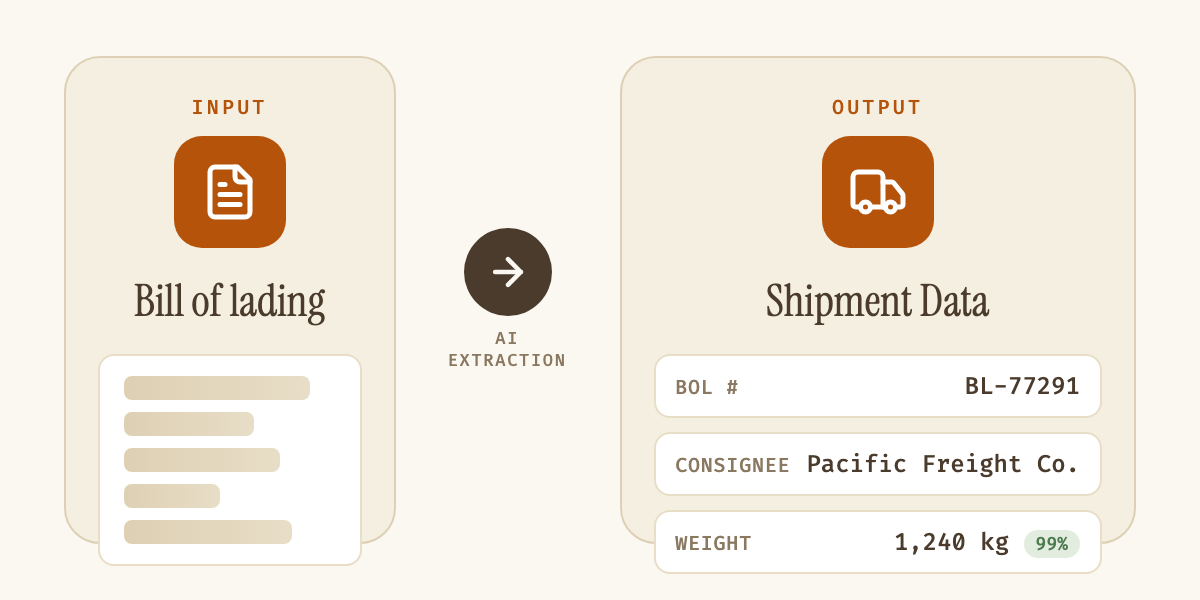
Line items and totals back with a confidence score per field, ready for the TMS, WMS, or the API.
Who uses this
Built for freight and fleet operations.
Freight & 3PL operations
Read bills of lading and packing lists from any carrier without a template per shipping line.
Fleet & service quotations
Normalize parts, labor, and totals from each workshop's PDF into one schema and sync it into your fleet system.
Warehouse & receiving
Match delivery receipts against purchase orders without a person re-keying line items at the dock.
Benchmarked accuracy
98.2% field accuracy, 99.9% on totals.
98.2%
Average field accuracy
99.9%
Financial totals
Benchmarked against SROIE2019, a public dataset of 347 real-world documents, with per-field results published openly.
See the full accuracy reportFAQ
Shipping & logistics extraction, answered.
What documents does shipping and logistics extraction cover?
Does it work across different carriers and workshops?
How accurate is line-item extraction on shipping documents?
Does it integrate with a TMS or fleet management system?
Can it handle handwritten notes on delivery receipts?
See it read your shipping documents.
Upload a real bill of lading or quotation and get structured data back in seconds, no template required.
Shipping and logistics extraction that reads every carrier's format.
Freight and fleet operations run on documents that were never designed to be machine-read: bills of lading, packing lists, and repair or service quotations, each carrier or workshop using its own layout, column order, and terminology. Shipping and logistics document extraction exists to normalize all of that into one structured schema.
| Document type | Fields extracted |
|---|---|
| Bill of lading | Shipper, consignee, BOL number, container number |
| Packing list | SKU, quantity, weight, carton count |
| Service quotation | Parts, labor, total |
A 3PL or freight forwarder working with dozens of carriers can't build and maintain a template for each one. Axia Extract reads document structure directly with AI, so a new carrier's bill of lading or a new workshop's quotation format works without a rebuild, the same schema applies across every source.
Freight and 3PL teams use it to read bills of lading and packing lists without a template per shipping line. Fleet operators use it to normalize parts, labor, and totals from each workshop's PDF into one schema and sync the result into a fleet management system through the REST API, a workflow covered step by step in our fleet service quotation guide. Warehouse and receiving teams use it to match delivery receipts against purchase orders without re-keying line items at the dock.
Axia Extract publishes its benchmark accuracy openly: 98.2% average field accuracy and 99.9% on financial totals, tested against SROIE2019, a public dataset of 347 real documents and detailed on the accuracy page. Handwritten fields, common on delivery receipts and site-visit notes, average 93.2% accuracy. Every field returns its own confidence score, so a low-confidence line item routes to review instead of getting accepted silently.