ID Document Extraction.
ID document extraction reads a passport, driver's license, or national ID and pulls out structured identity fields for KYC and onboarding. Axia Extract does it with AI-powered OCR built for accuracy, across ID formats from any country.
How it works
From ID document to verified fields, in three steps.
Define your schema
Full name, date of birth, ID number, expiry date, issuing authority — the fields your KYC or onboarding flow needs.
Upload the ID
Passports, driver's licenses, national IDs — a phone photo, scan, or PDF, from any country's document layout.
Get verified fields
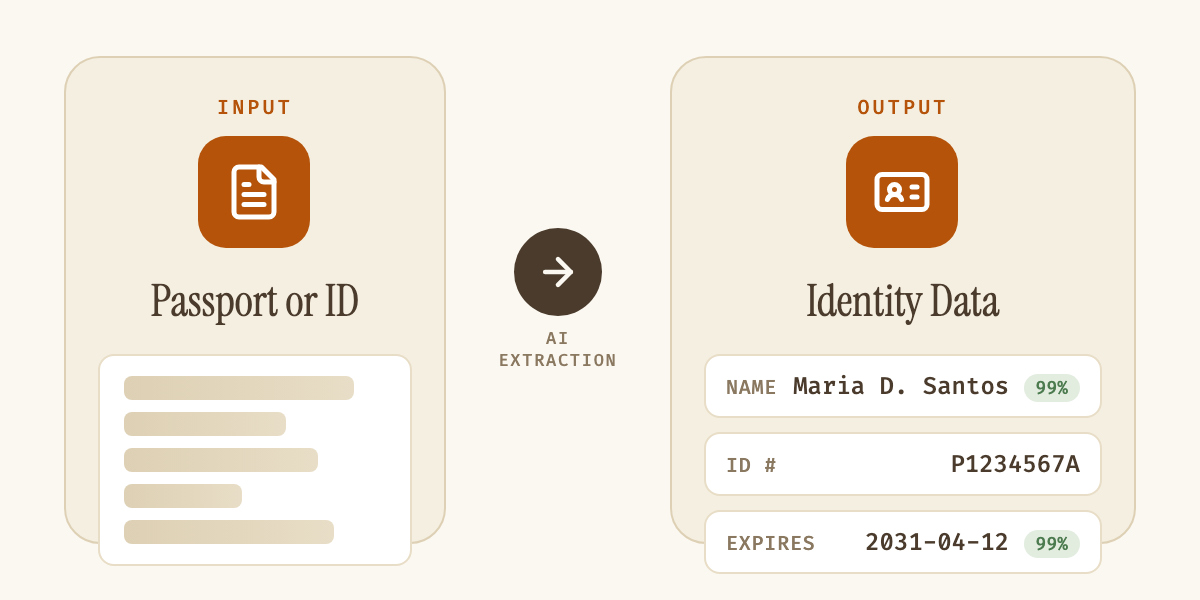
Structured identity data back with a confidence score per field, ready for the onboarding system or the API.
Who uses this
Built for onboarding at volume.
Fintech & digital banking onboarding
Pull identity fields the moment an applicant uploads an ID, before a compliance analyst opens the file.
KYC & AML compliance
Capture ID number, name, and expiry consistently across document types and countries for audit-ready records.
Marketplace & gig platform verification
Verify identity documents at signup volume without a manual review queue for every new user.
Benchmarked accuracy
98.2% field accuracy, 96.3% on dates.
98.2%
Average field accuracy
96.3%
Dates
Benchmarked against SROIE2019, a public dataset of 347 real-world documents, with per-field results published openly.
See the full accuracy reportFAQ
ID document extraction, answered.
What is ID document extraction?
Is this the same as KYC verification?
How accurate is it on ID documents?
Does it work across different countries' ID formats?
Does it integrate with an onboarding or compliance platform?
See it read your ID documents.
Upload a real ID document and get structured identity fields back in seconds, no template required.
ID document extraction that works across formats.
Identity verification is the first thing most fintech and marketplace platforms ask a new user to do, and it's still one of the slowest steps in onboarding. Someone uploads a passport or driver's license, and a person on the other end has to read the name, ID number, and expiry date off a photo that might be angled, glared, or cropped. ID document extraction exists to do that reading automatically.
| Document type | Fields extracted |
|---|---|
| Passport | Full name, passport number, nationality, date of birth, expiry date |
| Driver's license | Full name, license number, class, expiry date, address |
| National ID | Full name, ID number, date of birth, issuing authority |
Every country formats its ID documents differently, and every issuer updates its layout eventually. Template-based OCR needs a new template for each one and breaks on the next redesign. Axia Extract reads document structure directly with AI, so a new country's passport or a redesigned driver's license works without a rebuild.
Accuracy on identity fields matters for compliance, not just convenience: a misread ID number can misfile a KYC record. Axia Extract publishes its benchmark numbers openly, 98.2% average field accuracy and 96.3% on dates, tested against SROIE2019, a public dataset of 347 real documents and detailed on the accuracy page. Every field also returns its own confidence score, so a low-confidence read routes to manual review instead of getting accepted silently.
Fintechs, digital banks, and marketplace platforms use it to pull identity fields the moment an applicant uploads a document, feeding straight into whatever KYC, AML, or approval logic runs next. Pair it with bank statement extraction for full applicant income verification during the same onboarding flow. Our guide to AI data extraction covers how schema-based reading compares to rules-based tools more broadly. Results export to CSV, JSON, or Excel, or pull directly through the REST API into an onboarding or compliance system.