KYC document extraction for Philippine lending apps reads a PhilSys National ID, UMID, or payslip and returns the applicant's name, birthdate, ID number, and address as structured fields, verified against the application form, in seconds instead of minutes.
That speed matters more here than in most markets. Around 90 million Filipinos are registered with PhilSys, and BSP is actively pushing lenders toward national ID-based e-KYC (Biometric Update's coverage of the BSP push). An onboarding flow that can't read the ID most applicants actually hold is turning away the majority of its funnel before underwriting even starts.
Consumer apps built for this volume already treat the ID scan as the front door. GCash reports 56% of its users have presented the National ID when opening an account, and digital lenders operating at that scale process thousands of ID uploads a day, far past what a manual review queue can absorb without turning onboarding into the bottleneck.
What a lending app actually receives
Applicants don't submit one clean format. A PhilSys ID might arrive as a physical card photo, a printed paper version, or a screenshot of the digital app. Alongside it comes whatever secondary ID or income proof the applicant has on hand.
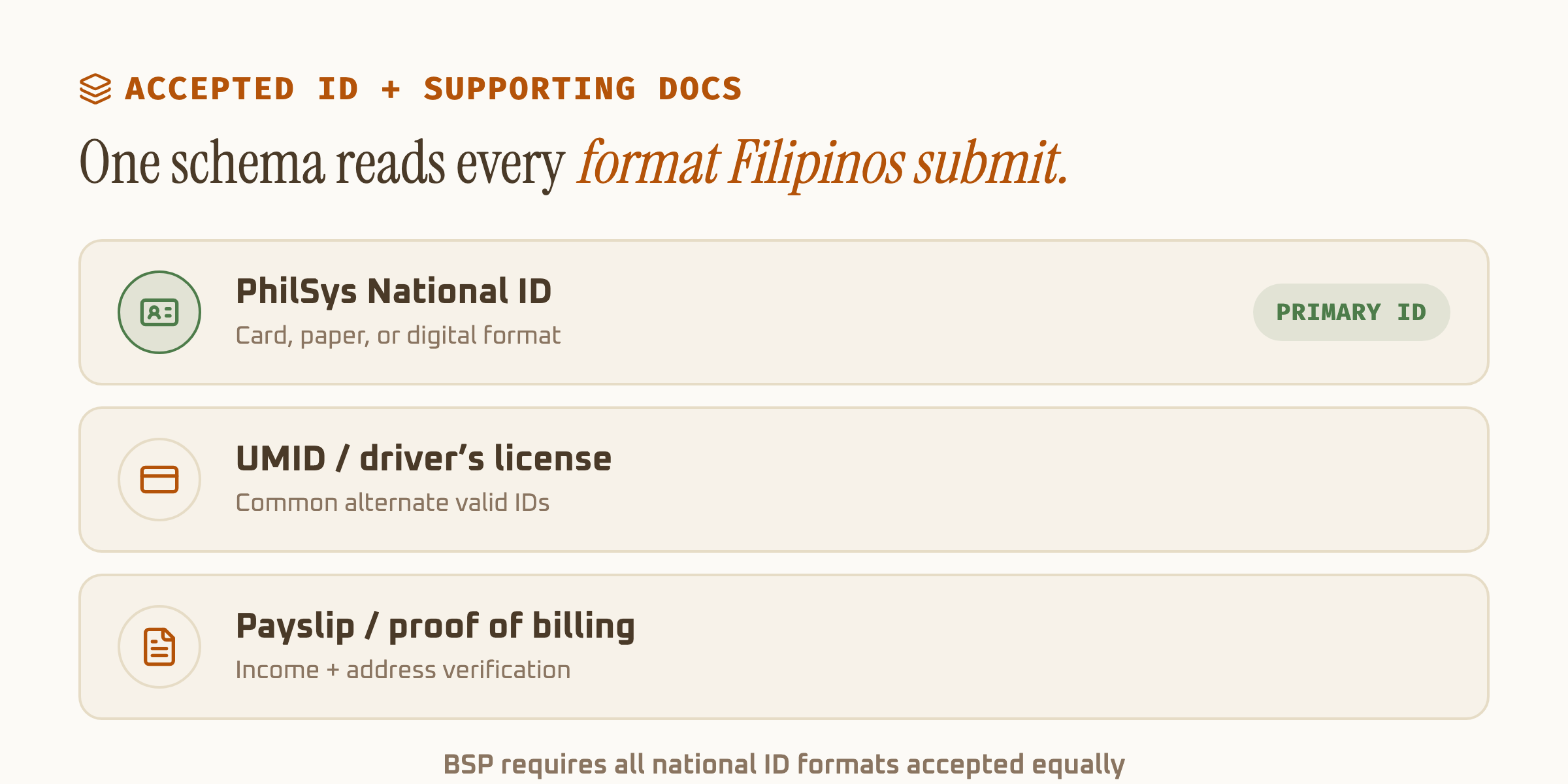
| Document | Fields extracted | Verifies |
|---|---|---|
| PhilSys National ID | PSN, full name, birthdate, address | Primary identity |
| UMID | CRN, name, birthdate | Secondary identity, SSS/GSIS-linked |
| Driver's license | License number, expiry, address | Secondary identity + address |
| Payslip | Employer, gross pay, pay period | Income for loan sizing |
| Proof of billing | Name, service address, due date | Address confirmation |
Where the National ID fits in the onboarding flow
BSP Memorandum 2025-012 requires every BSP-supervised institution to treat all three National ID formats, card, paper, digital, as equally valid. A 2026 draft memorandum goes further, directing banks and other supervised institutions to verify applicants against PSA's national ID database (NIDAS) during onboarding and account updates (BusinessWorld's report on the draft rule).
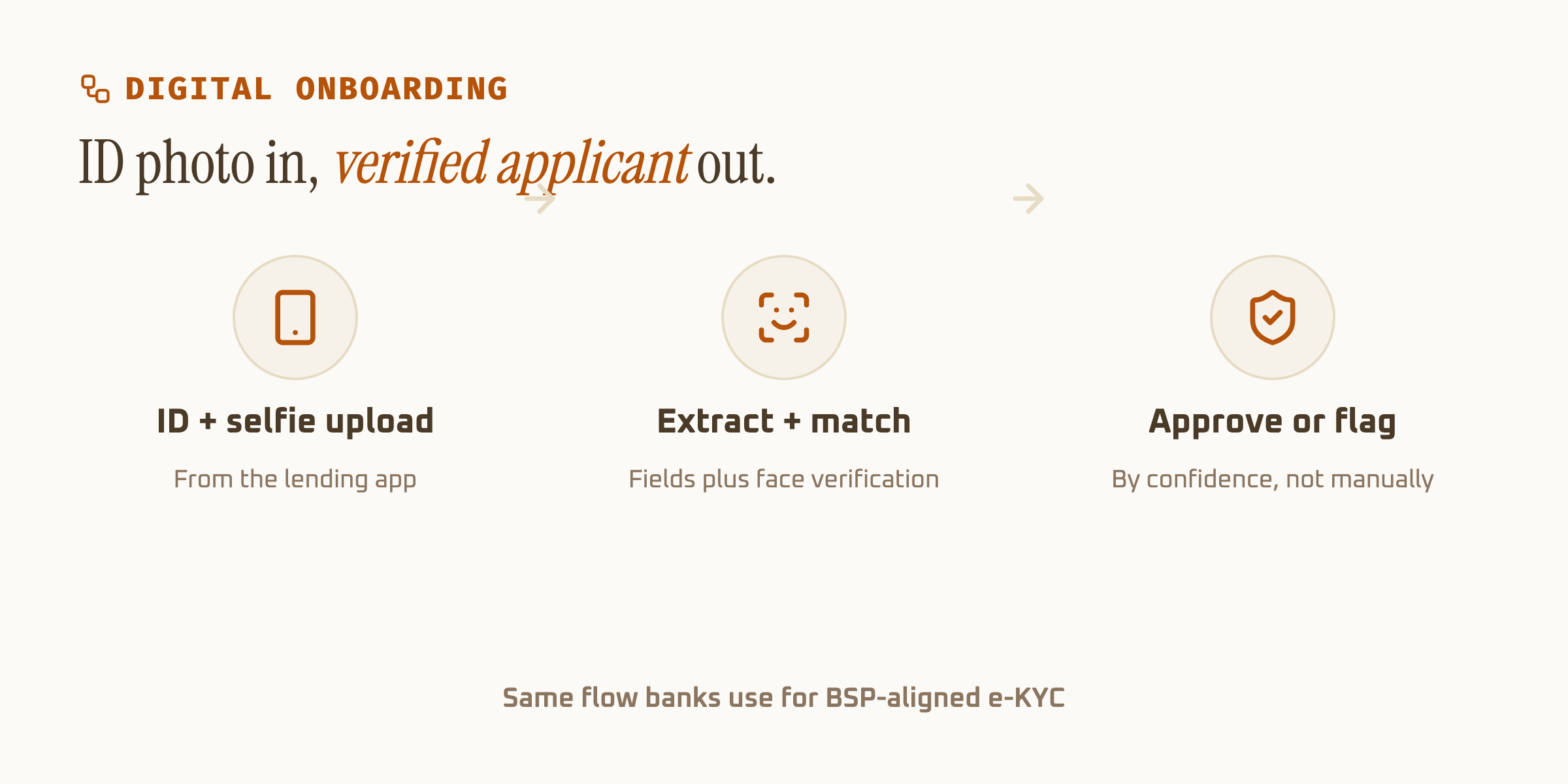
Extraction is the first link in that chain: turning a photographed ID into fields a verification layer can check. Get the extraction step wrong (a misread digit in the PSN, a name that doesn't match the OCR'd string exactly) and the verification step fails even when the applicant and their ID are both genuine.
There's also a data handling angle lenders can't skip. Extracted fields count as personal information under the Data Privacy Act, the same as the source ID image, so the pipeline needs the same retention and access controls either way, not a lighter standard just because the data is now structured instead of a photo.
What manual review actually costs per applicant
A reviewer reading an uploaded ID, keying the fields, and cross-checking them against the application form spends around twelve minutes per applicant. On a busy onboarding day, that queue is the difference between a same-day approval and a next-day one, and applicants abandon slow lending flows at a high rate.
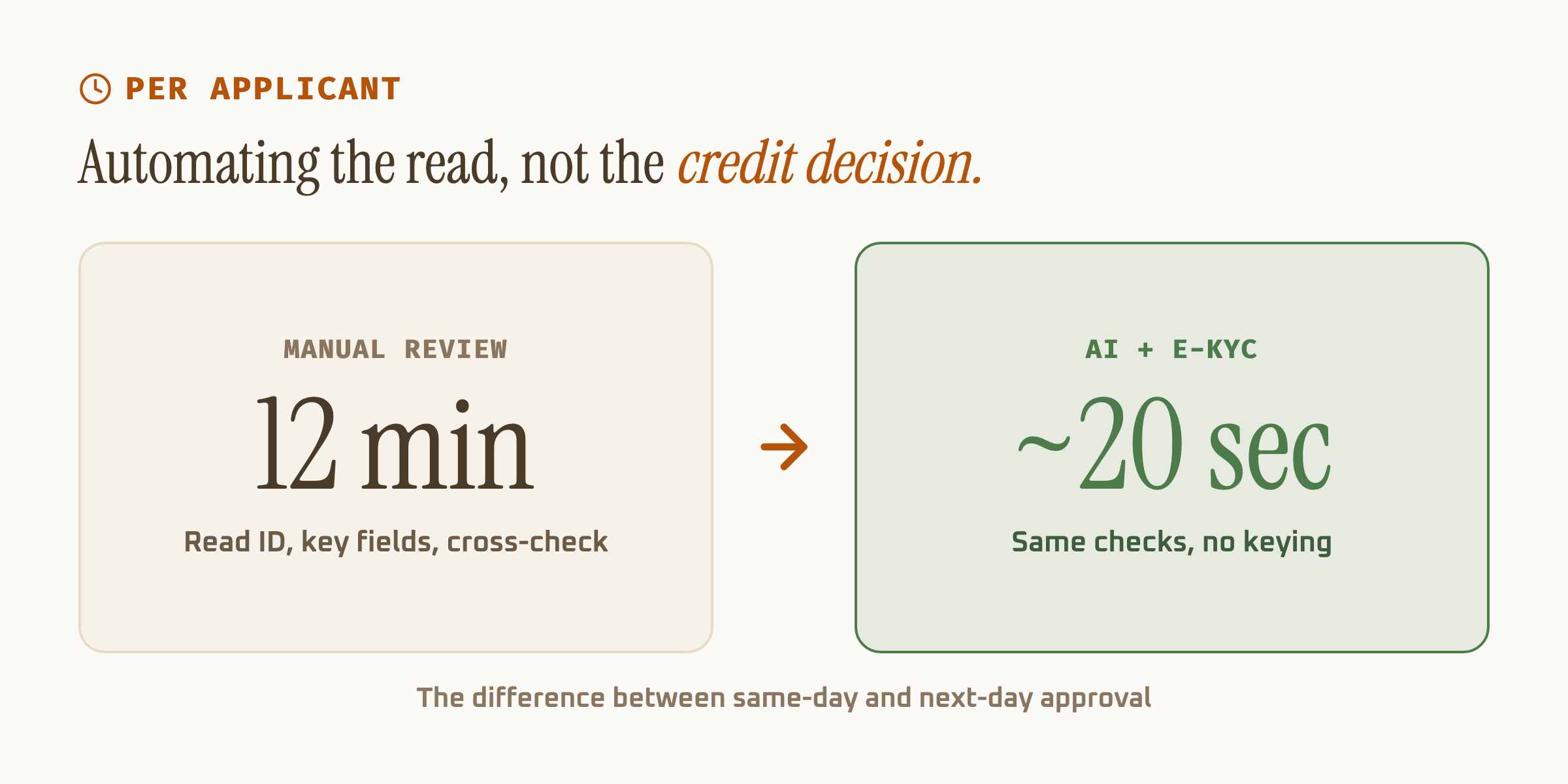
Speed isn't the only argument. Asia United Bank's HelloMoney app onboarded 169,847 Filipinos using National ID authentication between September 2024 and April 2025 (per PhilSys's own figures), a volume no manual review team processes at twelve minutes each without a large reviewer headcount.
Confidence scoring matters more here than elsewhere
A lending app can't treat every low-confidence field as a rejection. Phone camera photos of an ID are inconsistently lit, PhilSys paper copies fold and crease, and a strict all-or-nothing check would decline genuine applicants over image quality alone. The fix is the same confidence-based routing that works for other document types: score each field, auto-approve what's clear, and send only the uncertain field to a person.
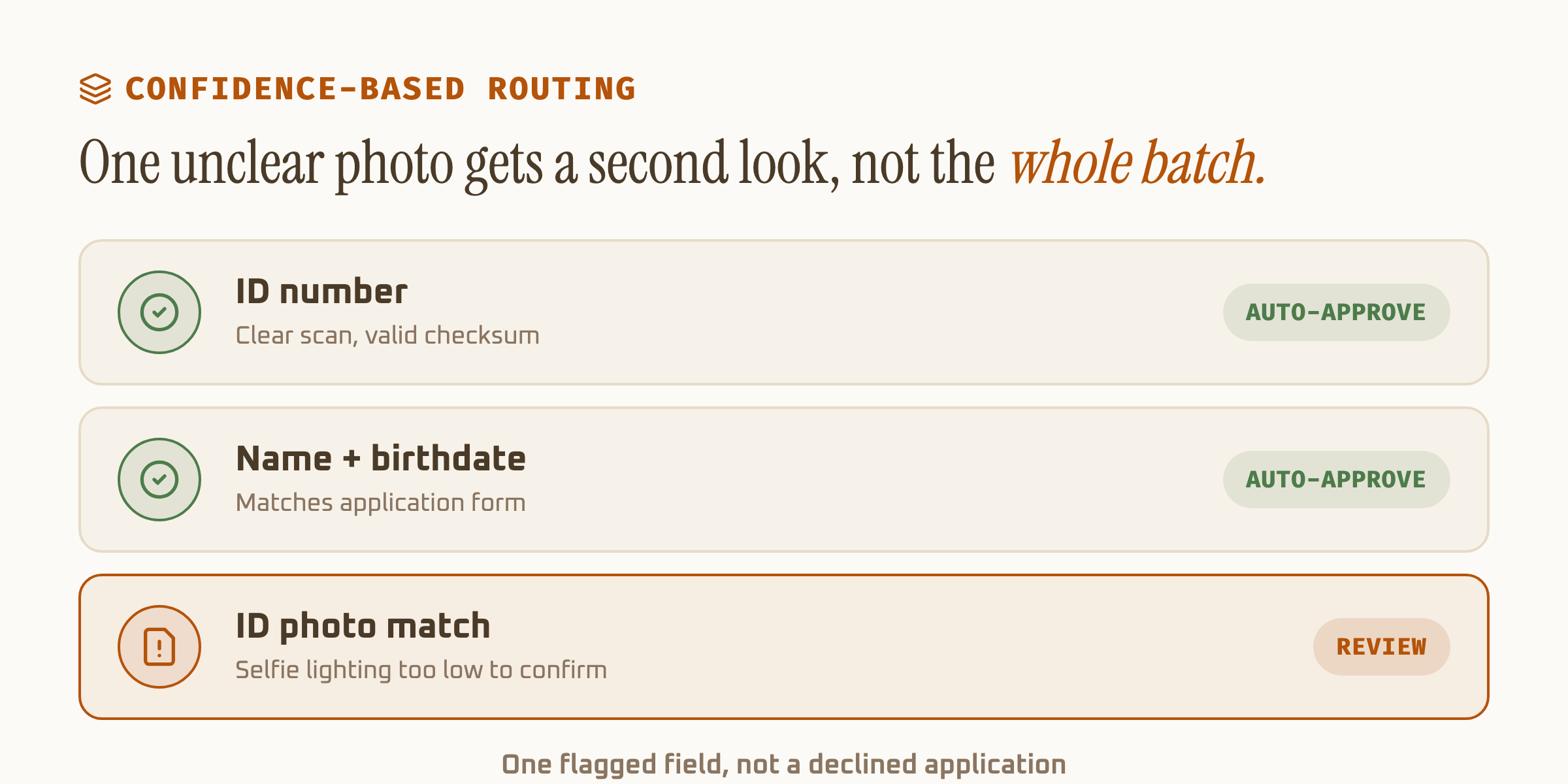
That's the same principle behind AI data extraction generally: review effort should track actual uncertainty, not apply uniformly to every submission regardless of how clean it is. For ID-specific extraction beyond lending onboarding, our ID document extraction page covers the schema and accuracy numbers in more depth.
Building this instead of buying it
A team can wire together an open-source OCR engine, a regex layer for PSN and CRN formats, and a manual review queue for the rest. It works at low volume. The maintenance cost shows up once ID formats drift, a PhilSys card redesign, a new UMID layout, and every downstream regex needs revisiting at the same time the applicant queue is growing.
Schema-based extraction sidesteps most of that. Define the fields once (PSN, name, birthdate, address), and the model locates them by context rather than a fixed position on the card, so a redesigned ID layout doesn't require rebuilding the pipeline. That's the same template-free approach that matters for any document type where the source format isn't fully in your control.